
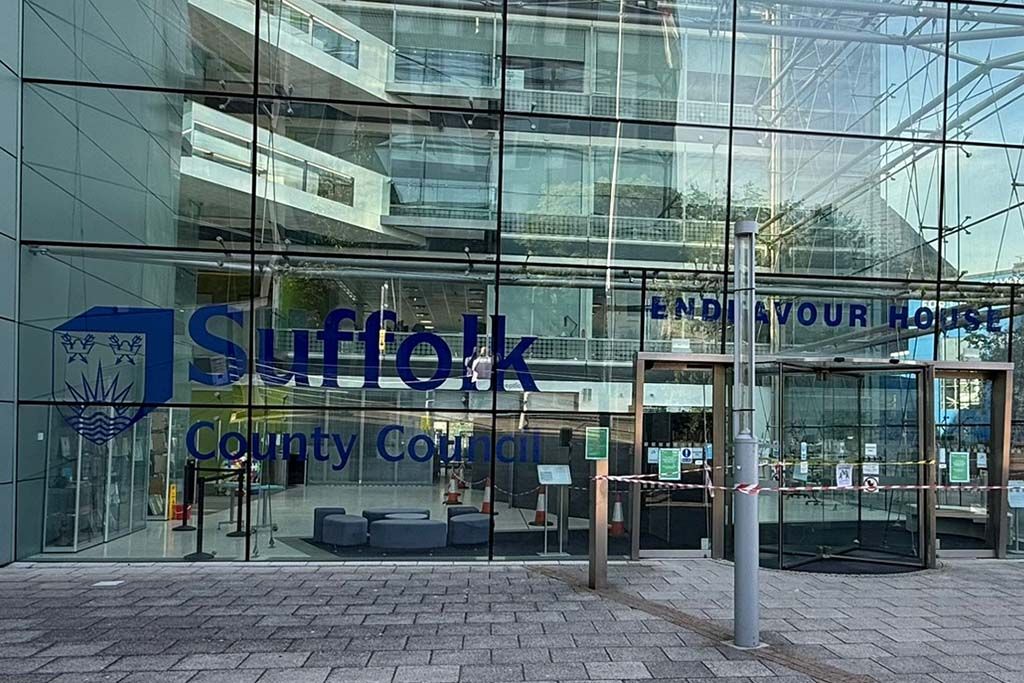
On Thursday 17 September Suffolk County Council’s Cabinet will consider a report from its own Monitoring Officer saying the council broke the law twice in taking one decision. The decision was the Leader’s alone, on 18 June, to issue judicial review proceedings over local government reorganisation. The first rule that was broken does not fall on officers. It says that as soon as reasonably practicable after a Cabinet member makes a decision on their own, that member must produce the written record of it, or instruct officers to. Not the council. Him.
When I raised the missing record at Cabinet on 29 June, the Leader’s answer was that it was “an officer delay, not a Cabinet delay”. The minutes of that meeting, also in Thursday’s papers, record him telling me the decision was taken in accordance with the Constitution. In the same set of papers his Monitoring Officer reports that it was not, but despite that, the report, which names Cllr Hadwen as its lead councillor, recommends that nothing more should be done about it.
Before the report was even published, the Leader was already telling the press it was all a minor procedural issue. Cabinet is required by law to consider the report and decide what to do about it. Cllr Hadwen seems to have already decided for them.
Be clear what this document is. It is a report under section 5A of the Local Government and Housing Act 1989, the power Parliament gave every council’s Monitoring Officer to tell the council’s Cabinet, formally and in writing, that it has broken the law. It is not used for routine slip ups. When it is invoked, the law stops the council acting on the decision until Cabinet has met to consider it, and every councillor must be sent a copy. It is so rare that each one is reported in the legal press as news, and nobody I have spoken with can remember one being issued in Suffolk ever before.
Parliament created the section 5A process because it decided that a council’s Cabinet breaking the law is never minor. Such a report is meant to have consequences. The administration has spent a month saying this breach is minor, and the report in front of Cabinet apparently agrees, because it recommends none. On Thursday Cabinet must decide whether it believes that, in public, on the record.
This report exists because I asked for it. On 25 June I asked where the record of the decision was, and it appeared the next day. On 29 June I put one question to the council’s lawyers: had the law been broken in the way this decision was made? Thursday’s report is the answer: it had. Nobody on the Reform benches asked it, and had I not, nobody would be any the wiser. I set out the full story in August and asked then for the Monitoring Officer’s findings to be published in full. They were not.
Instead, Cabinet gets a shorter version. The Monitoring Officer’s report of 3 August ran to 26 pages and went to group leaders marked sensitive because of the court case. The report, item 10 on Thursday’s agenda, is five pages. It took 37 days to reach councillors.
Cllr Hadwen’s defence rests on three words. Each breach is “minor and inadvertent”. The first was “a one-off error, which occurred when matters were having to be dealt with on an urgent basis”. Both “have suffered corrective action”, although the report does not say what the action was. Risk to the council: “Not applicable”.
One-off. Until this decision the council had never published a decision taken by a single Cabinet member. There was not even a page on the council’s website to put one on. A new page was hurriedly created to hold it, the day after I asked where the record was. A failure in a system that did not exist cannot be a one-off.
Minor. By the time the decision was published, the period in which councillors could have called it in, that is, questioned it before it took effect, had run out. I explained in August how the administration then removed that right for good by calling the decision urgent. The rule that was broken is the one that tells you a decision exists while there is still time to question it.
Inadvertent. The report itself records that the documents I asked for as a Scrutiny member were held back while “potentially difficult issues” about confidentiality were considered and then concludes the confidentiality point “probably did not apply”. The law gave the council ten days. I got them after 47. You do not deliberate for that length of time by accident.
The only justification ever given for keeping the 26 pages secret was the court case. That case is over, and the Leader has said he will publish the legal advice. The reason has gone, so the secrecy should go with it. Publish the full account now, so that Cabinet and the public are all looking at the same facts.
The end of the court case does not close this. The decision to bring it was the first big decision the Reform administration took, within weeks of winning power on a promise of openness, and this report is the first formal account of how a Reform council does its business: one man deciding, the record appearing after the time to question it had passed, the papers withheld, the finding called minor. Whether the case was right or wrong no longer matters. How it was decided does, because it is the only evidence residents have of how the next big decision will be taken.
On 29 June, as Labour Group Leader, I referred the whole decision to the Scrutiny Committee, the cross-party committee whose job is to check that decisions are made properly. That examination is on 1 October. The Monitoring Officer’s report looks at two breaches. The referral looks at the whole decision-making process, from the day the decision was taken to the day anyone was told. On Thursday, Cabinet can vote to accept that nothing more needs doing, or it can refer the whole process by which this decision was taken to the committee that exists to examine it. That choice will tell you more about this administration than anything in the report.
Cllr Martin Cook is Labour Group Leader at Suffolk County Council and county councillor for Rushmere.